How Much Does a Website Really Cost in Tanzania in 2026?
Let me be real with you — if you've searched "website cost in Tanzania 2026" and landed here, you're probably frustrated. You've asked three different developers, gotten three wildly different quotes, and you're no closer to understanding what a fair price actually looks like. I get it. I've been there, on both sides of that conversation.
Tanzania's digital economy is booming. Si unajua, the country has moved from a place where having a website was a luxury to one where not having one is a business risk. With internet penetration at around 32% and climbing, according to the DataReportal 2024 Digital Tanzania report, millions of Tanzanians are searching for products, services, and information online every single day. And yet, industry estimates suggest fewer than 20% of Tanzanian SMEs have a functional website. That gap? It's both a challenge and a massive opportunity.
Here's the honest truth about the cost of building a website in Tanzania: it ranges from as little as TZS 300,000 (around $100) for a bare-bones template site all the way up to tens of millions of shillings for a full enterprise solution. That's a huge range, and it's exactly why I wrote this guide — to break down every factor, every city, every website type so you can walk into your next developer meeting with real numbers and real confidence.
Whether you're a tour operator in Zanzibar, a government contractor in Dodoma, or a growing SME in Dar es Salaam, this guide covers your specific market. And if you're curious how these prices compare across the border, check out our 2026 Kenya website pricing guide — the parallels (and differences) might surprise you.
Twende kazi. Let's get into it.
Quick Answer: Website Costs in Tanzania (2026)
In 2026, a basic website in Tanzania costs $100–$750 (TZS 300,000–2,000,000), a professional business site costs $1,000–$5,000, and an e-commerce website with mobile money integration costs $2,000–$15,000. Enterprise solutions can exceed $50,000.
A Quick Note on Transparency
This guide is published by Quest, an East African web design agency that also offers the services described here. We've built it around verifiable market data and nine years of first-hand project experience, but you should treat it as both editorial research and a view of where we sit in the market. The pricing ranges reflect publicly available freelancer, agency, and regional rates — not just our own.
Tanzania's Digital Landscape in 2026: Why Web Presence Matters Now
Before we talk web design prices in Tanzania, let's set the scene — because context shapes everything when it comes to pricing.
Tanzania is in the middle of a genuine digital transformation. The Digital Tanzania Project, backed by $150 million from the World Bank, is expanding digital infrastructure across the country. The government's e-government push means more public services are moving online. And ICT is consistently flagged as one of Tanzania's fastest-growing sectors, outpacing several traditional segments of the economy.
What does this mean for web developer Tanzania pricing? More demand, more developers entering the market, and more options for businesses. But also more complexity.
Here's the city-by-city picture:
- Dar es Salaam remains Tanzania's undisputed tech hub. The majority of the country's active web developers and IT professionals are based here — numbering in the thousands, by industry estimates. More competition generally means more competitive pricing, but also higher quality at the upper end.
- Zanzibar is driven almost entirely by tourism tech. Hotels, tour operators, diving schools, spice tour companies — they all need booking-enabled, visually stunning websites. This creates a niche market with specific (and often higher) pricing.
- Dodoma, the political capital, is seeing steady growth in demand from government agencies, NGOs, and educational institutions. But the local developer talent pool is thin, which means many projects get outsourced to Dar es Salaam or even Nairobi-based agencies.
Mobile is by far the dominant internet access platform in Tanzania — per the DataReportal 2024 Digital Tanzania report, mobile connections account for the lion's share of digital engagement. That single statistic should shape every website decision you make — and it directly influences cost, because mobile-first design isn't optional here. It's survival.
"Tanzania's digital financial services continue to expand rapidly, with mobile payments reaching record levels in 2024 — a clear signal that businesses investing in a professional online presence today will lead the market tomorrow."
Website Cost Breakdown by Type in Tanzania (2026 Pricing Table)
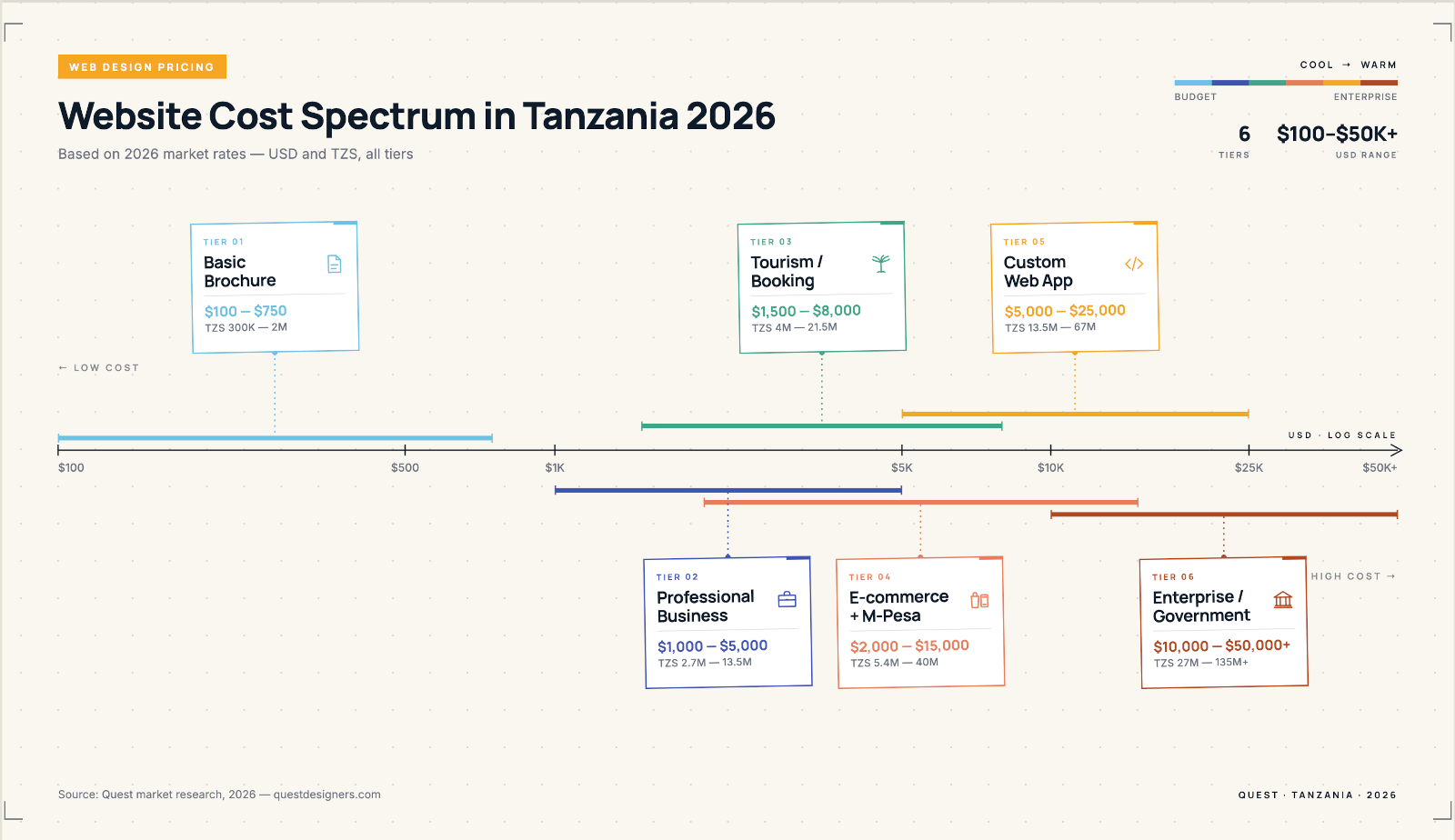
Right. Let's get to the numbers you came here for. The table below breaks down website cost in Tanzania 2026 by type, with pricing in both USD and TZS. I've based these on current market rates from local freelancers, Dar es Salaam agencies, and regional East African providers like Quest.
| Website Type | Cost Range (USD) | Cost Range (TZS) | Timeline | Best For |
|---|---|---|---|---|
| Basic Informational / Brochure Site | $100 – $750 | TZS 300K – 2M | 1 – 2 weeks | Small businesses, personal brands, startups |
| Professional Business Website | $1,000 – $5,000 | TZS 2.7M – 13.5M | 2 – 6 weeks | Established SMEs, professional services |
| E-Commerce Website (with Mobile Money) | $2,000 – $15,000 | TZS 5.4M – 40M | 4 – 12 weeks | Online shops, retailers, product-based businesses |
| Booking / Tourism Website | $1,500 – $8,000 | TZS 4M – 21.5M | 3 – 8 weeks | Hotels, tour operators, travel agencies |
| Custom Web Application | $5,000 – $25,000 | TZS 13.5M – 67M | 8 – 20 weeks | SaaS products, portals, internal tools |
| Enterprise / Government Portal | $10,000 – $50,000+ | TZS 27M – 135M+ | 12 – 40 weeks | Government, large NGOs, corporations |
A few things to note about these ranges:
- The lower end of each range typically means template-based design, limited pages (5-10), and minimal custom functionality.
- The upper end includes custom design, advanced features (booking engines, payment integration, multi-language support), and professional content creation.
- WordPress powers over 42% of all websites globally and is by far the dominant CMS in the Tanzanian developer community — and for good reason. It keeps development costs lower while offering flexibility. If you're weighing your options, our article on custom web design vs. WordPress templates breaks down the pros and cons.
Now, let me add something from my own experience. When I was working with clients in Dar es Salaam during my time with Clouds Media, I noticed that many businesses came in asking for a "cheap website" but what they actually needed was a professional one. There's a difference. A cheap website development Tanzania approach — say, a $200 template site — might look okay on day one. But six months later, when it's not ranking on Google, doesn't work properly on phones, and can't process payments? That's when the real cost hits. Pole pole ndio mwendo — invest wisely from the start.
Web Design Prices in Zanzibar: Tourism, Hospitality & Beyond
Zanzibar holds a special place in my heart — and in the East African web design market. I've worked on content for tourism clients across the region, and Zanzibar's digital needs are genuinely unique.
Zanzibar welcomed a record 736,755 international tourists in 2024 — a 15.4% jump over 2023 — according to the Office of the Chief Government Statistician Zanzibar. Every single one of those tourists starts their journey online — searching for hotels, comparing dive schools, booking spice tours. If your Zanzibar business doesn't have a professional website with booking capability, you're literally handing customers to your competitors.
Here's what drives website development cost in Zanzibar higher than mainland averages:
Booking Engine Integration ($500 – $3,000)
Tour operators and hotels need real-time booking systems. Whether it's a simple calendar-based form or a full integration with platforms like Beds24 or FareHarbor, this functionality adds significant development time and cost. Budget $500 minimum for a basic booking form, and $1,500-$3,000 for a proper engine with availability management.
Multi-Currency Payment Processing ($300 – $1,500)
Your Zanzibar website needs to accept payments from international tourists (Stripe, PayPal, credit cards in USD, EUR, GBP) and local customers (M-Pesa, Tigo Pesa). That dual requirement means integrating multiple payment gateways — and each one adds complexity and cost.
Multi-Language Support ($200 – $1,000)
At minimum, you'll need English and Swahili. Many tourism sites also add French, German, or Italian depending on their target markets. Each language requires translation, content management setup, and SEO optimization in that language.
Gallery-Heavy, Visual Design ($300 – $1,500)
Tourism sells on visuals. Those turquoise waters, white sand beaches, and sunset dhow cruises need to look stunning on every screen size. This means professional photography integration, image optimization for speed, and responsive design that doesn't compromise on visual impact.
All told, a proper tourism website in Zanzibar typically costs between $1,500 and $8,000 — with the sweet spot for most small-to-medium hospitality businesses sitting around $2,500-$5,000.
The Zanzibar tech scene is growing, with a small but talented pool of local developers. However, many businesses still outsource to Dar es Salaam agencies or work with regional partners across East Africa. The beauty of it is that remote collaboration has become so normal post-2020 that geography matters less than it used to — what matters is finding someone who understands the tourism market.
Zanzibar Tourism Tip
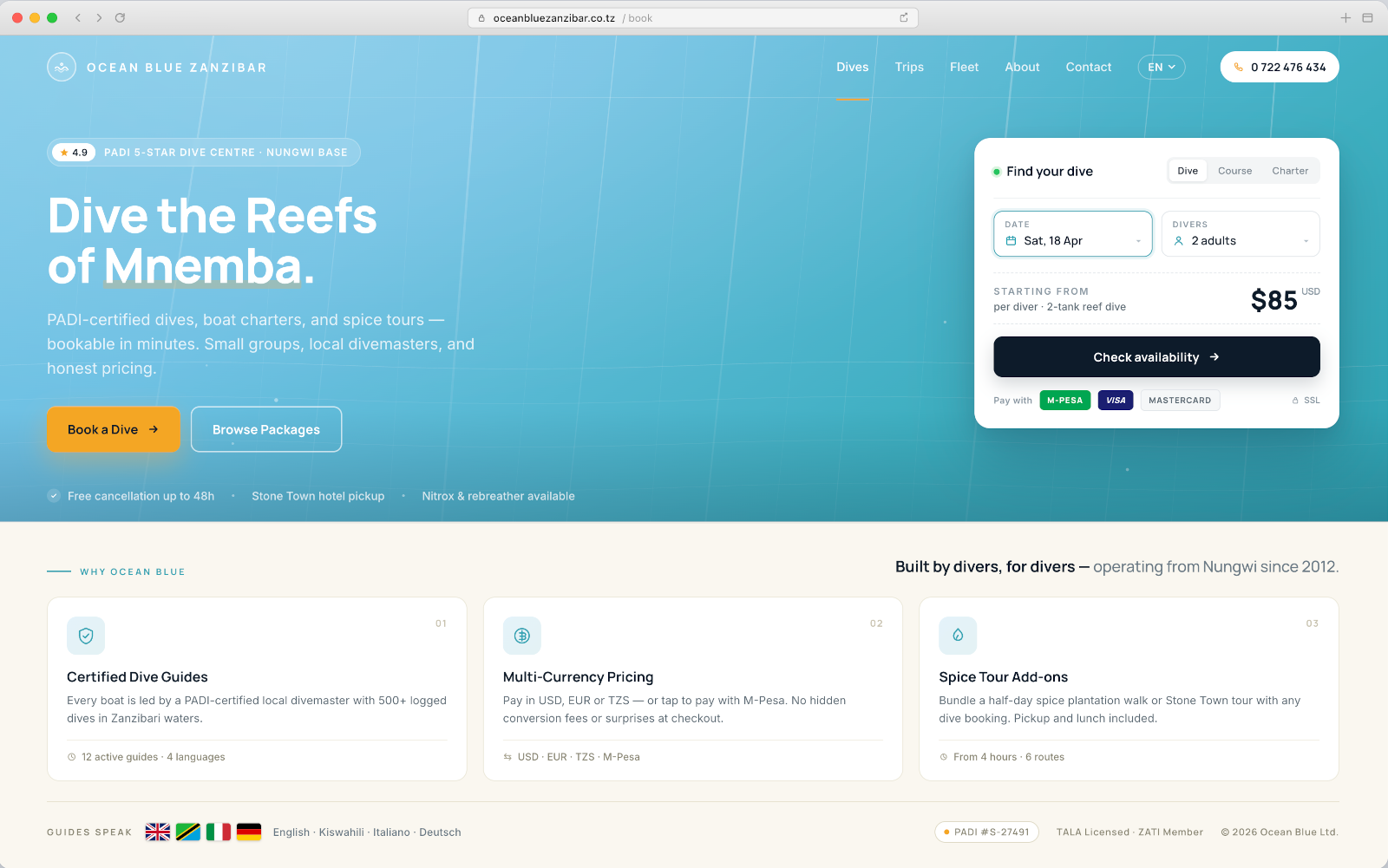
If you run a tourism business in Zanzibar, budget an extra $500–$2,000 for a proper booking engine and multi-currency payment integration. These features directly drive revenue and pay for themselves within months. Don't skimp here — this is where your ROI lives.
Website Development Costs in Dodoma: Government, NGOs & Growing Businesses
Dodoma is a different story entirely. As Tanzania's political capital, the city's website design market is shaped by institutional needs rather than tourism or e-commerce.
The primary demand drivers here are:
- Government service portals — ministries, regional offices, and public agencies moving services online as part of Tanzania's e-government initiative
- NGO and nonprofit websites — project showcase sites, donor-facing portals, and impact reporting platforms
- Educational institution sites — universities, colleges, and training centres needing student portals and information systems
- Emerging local businesses — as Dodoma grows as a political and administrative centre, local SMEs are starting to invest in their online presence
Here's the pricing reality in Dodoma: the local tech talent pool is significantly smaller than Dar es Salaam's. Most experienced web developers in Tanzania gravitate toward Dar, where the money and the clients are. This means many Dodoma-based projects get outsourced to Dar es Salaam agencies — and that outsourcing typically comes with a 30-50% price premium over what a comparable local developer might charge.
A local Dodoma freelancer might build a basic website for $150-$500, but quality and reliability vary enormously. A Dar es Salaam agency handling a government or NGO website for a Dodoma client will typically quote $3,000-$15,000 depending on complexity. Some organisations even work with Nairobi-based agencies like Quest that serve the broader East African market.
My advice for Dodoma-based organisations? Don't choose solely on price. I've seen too many government and NGO projects go sideways because the cheapest quote won. Ask for portfolios. Check references. And if you're building something that needs to handle sensitive data or high traffic — like a government service portal — invest in a professional team that understands security and scalability.
Web Design Prices in Arusha: Safari Tourism & International NGO Hub
You cannot talk about web design in Tanzania and skip Arusha. As the gateway to the Serengeti, Ngorongoro, and Mount Kilimanjaro, Arusha is Tanzania's undisputed safari tourism capital — and home to hundreds of tour operators, lodges, and boutique hotels whose websites are their storefronts.
Arusha also hosts major international organisations. The East African Community (EAC) headquarters, the UN International Residual Mechanism for Criminal Tribunals (formerly the ICTR), and a dense cluster of INGOs all contribute to steady demand for professional, multilingual web presences.
Pricing in Arusha looks a lot like Zanzibar's market — driven by tourism, but with more NGO and institutional work layered on top:
- Safari tour operator sites: $1,500 – $6,000 (booking engines, gallery-heavy visuals, multi-currency)
- Lodge & boutique hotel sites: $1,200 – $5,000
- NGO & institutional sites: $2,000 – $10,000 (donor portals, bilingual content, accessibility standards)
- Local SME sites: $300 – $2,500
The local Arusha developer pool is smaller than Dar es Salaam's but more specialised — many freelancers have grown up on safari and hospitality briefs. For bigger builds, most Arusha operators still partner with Dar es Salaam agencies or regional East African firms like Quest. If your safari business is your main revenue engine, don't gamble on the cheapest quote — the cost of a broken booking during peak season is never $500.
What Factors Influence Website Cost in Tanzania?
When it comes to content — and web design — the devil is always in the details. Here are the ten factors that move the price needle up or down for any website project in Tanzania.
1. Design Complexity: Template vs. Custom
A pre-built WordPress template might cost you $0-$100 for the theme itself, with development costs of $200-$1,000 to customise it. A fully custom design — unique layouts, bespoke graphics, brand-specific UI — can add $1,000-$10,000+ to your project. If you're unsure which route to take, our comparison of custom design vs. WordPress templates will help you decide.
2. Number of Pages & Content Volume
A 5-page brochure site is a fundamentally different project from a 50-page content-rich platform. Every additional page means more design, more development, and more content. Most agencies price by page count or by project scope — expect to pay $50-$200 per additional page beyond the standard package.
3. Mobile-First & Responsive Design
With over 90% of Tanzanian internet users on mobile devices, responsive design isn't an add-on — it's the foundation. Any developer who quotes you for a desktop-only site in 2026 is not someone you want to work with. Period. Mobile-first design should be included in every quote, but it does add 15-25% to development time compared to desktop-only builds.
4. E-Commerce & Payment Integration
This is where e-commerce website cost in Tanzania gets interesting. A basic product catalogue is one thing. Full shopping cart functionality with M-Pesa, Tigo Pesa, and Airtel Money integration? That's a significant technical undertaking. More on this in the next section, but budget $500-$3,000 for payment integration alone.
5. CMS Platform Choice
WordPress dominates in Tanzania, and for good reason — it's cost-effective, well-supported, and most local developers know it well. Custom CMS solutions or frameworks (Laravel, Django, React-based) cost 2-5x more to develop but offer greater flexibility for complex applications.
6. SEO & Digital Marketing Setup
A website nobody can find is a website that doesn't exist. Basic on-page SEO setup (meta tags, site structure, speed optimization) should be included in any professional build. Advanced SEO — keyword research, content strategy, local SEO for Tanzanian markets — adds $300-$2,000 to the initial project.
7. Multi-Language Support (Swahili/English)
As a creative who believes deeply in the power of Swahili in content, I always recommend bilingual websites for Tanzanian businesses. But hii ni kweli — multi-language setup adds complexity. You'll need proper content management for each language, URL structure decisions, and potentially separate SEO strategies. Budget $200-$1,000 for bilingual setup.
8. Developer Location & Type
A freelancer in Mwanza charges differently from an agency in Dar es Salaam, which charges differently from a Nairobi-based firm. Local freelancers: $100-$2,000. Tanzanian agencies: $1,000-$15,000. Regional East African agencies: $1,500-$20,000+. The price reflects not just skill, but also support, reliability, and project management capacity.
9. Hosting & Domain Costs
Often overlooked in initial quotes. Domain registration for .co.tz or .or.tz through tzNIC costs approximately $40-$80/year. Hosting ranges from $5-$50/month for shared hosting to $50-$300/month for dedicated or cloud hosting. More on this in the hidden costs section below.
10. Ongoing Maintenance
Websites are not "build and forget" projects. Security updates, plugin updates, content changes, performance monitoring — all of this costs money. Annual maintenance typically runs $200-$2,000/year depending on complexity.
Beware of Suspiciously Low Quotes
A $100 website might save you money upfront, but poor code quality, no mobile responsiveness, and zero SEO can cost your business thousands in lost customers. Always ask to see a developer's portfolio before committing. If they can't show you at least 3-5 live websites they've built, walk away.
Mobile Money Integration: A Hidden Cost Driver for Tanzanian Websites
This section deserves its own spotlight because mobile money is the beating heart of Tanzania's digital economy — and it's one of the biggest cost variables in any Tanzanian website project.
Mobile money transactions in Tanzania reached a record TZS 198.9 trillion (roughly USD 75 billion) in 2024 — a 28.5% jump over 2023 — according to the Bank of Tanzania 2024 Payment Systems Report. M-Pesa, Tigo Pesa, and Airtel Money aren't just payment options — they're how most Tanzanians transact. If your e-commerce or service-based website can't accept mobile money, you're cutting off the majority of your potential customers.
But here's what many businesses don't realise: integrating mobile money into a website is technically complex. It's not like dropping in a PayPal button.
What's Involved in Mobile Money Integration
- API integration — connecting your website to the mobile money provider's system (M-Pesa API, Tigo Pesa API, etc.)
- Payment gateway setup — using intermediary platforms like Flutterwave, DPO Group, or Selcom to handle transactions
- Security implementation — SSL certificates, data encryption, PCI compliance considerations
- Testing and certification — each payment provider has its own testing and approval process
- Transaction handling — callbacks, payment confirmation, refund processing, failed transaction management
Typical Cost: $500 – $3,000
A single mobile money provider integration through a gateway like Selcom might cost $500-$1,000. Full multi-provider integration (M-Pesa + Tigo Pesa + Airtel Money + international cards) can run $1,500-$3,000. For a detailed technical walkthrough, our M-Pesa Daraja API integration guide covers the process — and while it's focused on Kenya's M-Pesa, the principles are very similar for Tanzania's implementation.
Compare this with international payment gateways: Stripe or PayPal integration is typically simpler and cheaper ($200-$500) because they have better-documented APIs and wider developer familiarity. But they don't serve the local Tanzanian market the way mobile money does.
At the end of the day, if you're building an e-commerce website in Tanzania, mobile money integration isn't optional — it's essential. Budget for it from the start.
Get East African Web & Digital Insights
Join 5,000+ business owners across Kenya, Tanzania, and Uganda who receive our weekly tips on web design, SEO, and digital growth. Subscribe free — no spam, just actionable advice.
Freelancer vs. Agency vs. DIY: Comparing Your Options in Tanzania
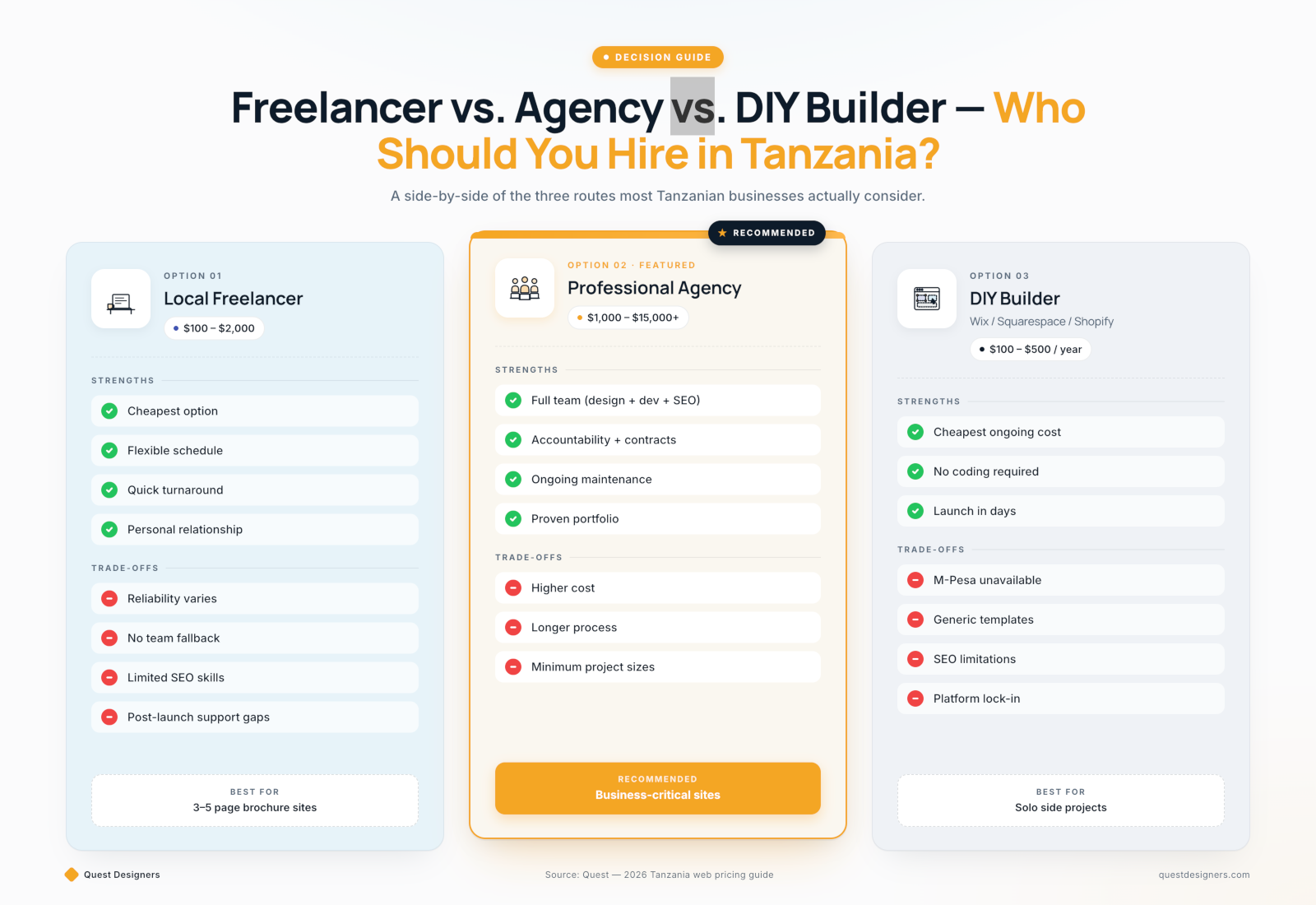
One of the most common questions I hear from Tanzanian business owners is: "Should I hire a freelancer, go to an agency, or just build it myself?" The answer depends on your budget, your timeline, and honestly — how much risk you're willing to take.
Local Freelancers ($100 – $2,000)
Pros: Cheapest option, flexible on timelines, often willing to negotiate. You can find talented self-taught developers in Dar es Salaam, Arusha, and even Mwanza who do solid work.
Cons: Reliability is the biggest issue. I've heard too many stories — and experienced a few myself — of freelancers disappearing mid-project. No ongoing support, limited design skills (many are developers first, designers second), and if they get sick or take another job, your project stalls.
Best for: Very small businesses with tight budgets and simple needs. A 3-5 page brochure site with no complex functionality.
Professional Agencies ($1,000 – $15,000+)
Pros: Quality, accountability, full-service (design + development + content + SEO). You get a team, not a single point of failure. Professional agencies in Dar es Salaam or Nairobi offer project management, contracts, and ongoing maintenance plans.
Cons: Higher cost. Potentially slower turnaround because of process and quality control. Some agencies have minimum project sizes that price out very small businesses.
Best for: Established businesses, tourism operators, NGOs, and any company where their website is a critical revenue or credibility tool. If your website is your shopfront — and in 2026, it usually is — this is where you should invest.
DIY Website Builders ($100 – $500/year)
Pros: Cheapest ongoing cost. Platforms like Wix, Squarespace, and Shopify make it possible to build a decent-looking site without any coding knowledge. Good for testing an idea quickly.
Cons: Limited customisation. Poor local payment integration — try getting M-Pesa or Tigo Pesa working on Squarespace and you'll understand. Generic designs that don't differentiate your brand. SEO limitations. And you're locked into their platform.
Best for: Solo entrepreneurs, side projects, or businesses that need a simple web presence while they save up for a professional build.
| Factor | Freelancer | Agency | DIY Builder |
|---|---|---|---|
| Cost Range | $100 – $2,000 | $1,000 – $15,000+ | $100 – $500/year |
| Quality | Variable | High | Medium |
| Customisation | Medium | High | Low |
| Mobile Money Integration | Possible | Yes | Very Limited |
| Ongoing Support | Unlikely | Yes | Platform-dependent |
| Timeline | 1 – 4 weeks | 2 – 12 weeks | 1 – 7 days |
| Reliability | Low – Medium | High | High (platform) |
As someone who grew up professionally at Quest — starting as an intern and working my way through nine years of East African web projects — I've seen every combination work and fail. The pattern is clear: businesses that invest in professional web development consistently outperform those that cut corners. Not always immediately, but within 6-12 months, the difference in traffic, leads, and revenue becomes obvious.
Hidden & Recurring Costs: What Tanzanian Businesses Often Forget
Here's where many Tanzanian businesses get caught off guard. They budget for the build — and then reality hits. A website is not a one-time purchase. It's an ongoing commitment, like rent for a digital shopfront.
1. Domain Registration ($10 – $80/year)
A .co.tz or .or.tz domain through tzNIC costs approximately $40-$80/year. International domains (.com, .org) are cheaper at $10-$20/year. You need to renew annually — let your domain lapse and someone else can grab it.
2. Web Hosting ($100 – $1,000/year)
Shared hosting runs $5-$15/month ($60-$180/year). VPS or cloud hosting for higher-traffic sites costs $20-$80/month ($240-$960/year). For a detailed breakdown, our web hosting guide covers the differences between hosting types — the principles apply across East Africa.
3. SSL Certificates
Often included free with modern hosting (via Let's Encrypt), but some hosting providers charge $20-$100/year for premium SSL. Either way, SSL is non-negotiable in 2026 — Google penalises non-HTTPS sites, and your customers need to see that padlock icon.
4. Annual Maintenance & Updates ($200 – $2,000/year)
WordPress plugins need updating. Security patches need applying. PHP versions need upgrading. Content needs refreshing. If you're not paying someone to maintain your site, you're gambling with your online presence. Many agencies, including Quest, offer annual maintenance packages that cover all of this.
5. Content Creation & Photography ($200 – $2,000)
Stock photos only get you so far. Professional photography of your products, team, or property makes a massive difference — especially for tourism businesses in Zanzibar. Budget $200-$500 for basic photography, $500-$2,000 for professional shoots.
6. SEO & Digital Marketing (Ongoing: $200 – $1,000/month)
Building a website without SEO is like opening a shop in a basement with no signage. Ongoing digital marketing — content updates, keyword optimization, Google My Business management, social media — is what turns a website from a cost into an investment.
7. Security & Backup Solutions ($50 – $300/year)
Automated backups, malware scanning, firewall protection. These aren't glamorous, but they'll save you when (not if) something goes wrong.
Total Cost of Ownership: A Real Example
Let's put this together for a typical professional business website in Tanzania:
- Year 1: Website build ($2,500) + hosting ($200) + domain ($50) + maintenance ($500) + basic SEO setup ($300) = $3,550
- Year 2 and beyond: Hosting ($200) + domain ($50) + maintenance ($500) + SEO ($300) = $1,050/year
That's the real cost of building a website in Tanzania. Not just the build — the full picture.
Total Cost of Ownership Example
A professional business website in Tanzania might cost $2,500 to build, but factor in hosting ($200/year), maintenance ($500/year), domain ($50/year), and basic SEO ($300/year) — your true Year 1 cost is closer to $3,550, with $1,050 recurring annually. Plan for it.
How to Get the Best Value for Your Website Investment in Tanzania
I've worked on content strategies for businesses across Kenya, Tanzania, and Uganda over the past nine years. And if there's one thing I've learned, it's this: the businesses that get the best return on their website investment aren't necessarily the ones that spend the most — they're the ones that spend smartly. Here are my top tips.
1. Define Your Requirements Before You Talk to Anyone
Write down exactly what you need. How many pages? Do you need e-commerce? Which payment methods? What languages? The more specific your brief, the more accurate your quotes will be — and the less room there is for scope creep and surprise costs.
2. Get at Least 3 Quotes — and Compare Scope, Not Just Price
A $500 quote and a $3,000 quote might be for completely different deliverables. Always ask: What's included? What's not included? How many revision rounds? Is mobile optimization included? What about SEO setup? Compare apples to apples.
3. Start with an MVP and Scale
You don't need every feature on day one. Launch with a clean, professional 5-10 page site. Get it live. Start generating traffic and leads. Then add e-commerce, booking engines, or advanced features as your revenue justifies the investment. Trust the process.
4. Prioritise Mobile-First Design
I cannot stress this enough. Over 90% of your Tanzanian visitors are on phones. If your site doesn't look and work beautifully on a smartphone screen, nothing else matters. Make mobile-first design your non-negotiable requirement.
5. Choose WordPress for Cost-Effectiveness
Unless you need genuinely custom functionality (a SaaS platform, a complex portal), WordPress is your best bet in the Tanzanian market. The developer pool is large, themes and plugins keep costs down, and it's proven technology. Save the custom builds for when your business demands it.
6. Budget for Maintenance from Day One
Include at least $500-$1,000/year in your website budget for ongoing maintenance. It's not exciting, but it's what keeps your site secure, fast, and functional. Think of it like servicing your car — skip it and eventually something expensive breaks.
7. Consider East African Agencies That Understand Your Market
There's real value in working with an agency that understands East African business culture, payment systems, and consumer behaviour. A developer in Europe or India might be technically skilled, but they won't instinctively know that your Tanzanian customers expect to pay via M-Pesa, or that your Zanzibar hotel site needs to load fast on a 3G connection. Agencies like Quest in Nairobi have been serving the East African market for years — that regional knowledge matters.
8. Invest in SEO from the Start
Every shilling you spend on SEO during the build phase saves you money later. Proper site structure, keyword-optimised content, fast loading speeds, clean code — these things are much cheaper to build in from the start than to retrofit later. And they're what will bring you organic traffic for years to come.
I once drafted an entire content strategy on my phone during a matatu ride from Kikuyu to Nairobi CBD — copy, keyword targets, content calendar, the works. My colleagues call it "matatu genius." I call it making peace with Nairobi traffic. But the point is this: great strategy doesn't require a big budget. It requires clear thinking and smart priorities. The same applies to your website investment.
"The biggest mistake Tanzanian SMEs make is treating their website as a one-time expense rather than an ongoing investment. The businesses that budget for maintenance, content updates, and SEO consistently outperform those that build and forget."
Website Cost in Tanzania vs. Other East African Countries
How do web design prices in Tanzania stack up against the rest of East Africa? Here's a comparative look based on current market rates:
| Website Type | Tanzania | Kenya | Uganda | Rwanda |
|---|---|---|---|---|
| Basic Brochure Site | $100 – $750 | $200 – $1,000 | $100 – $700 | $150 – $800 |
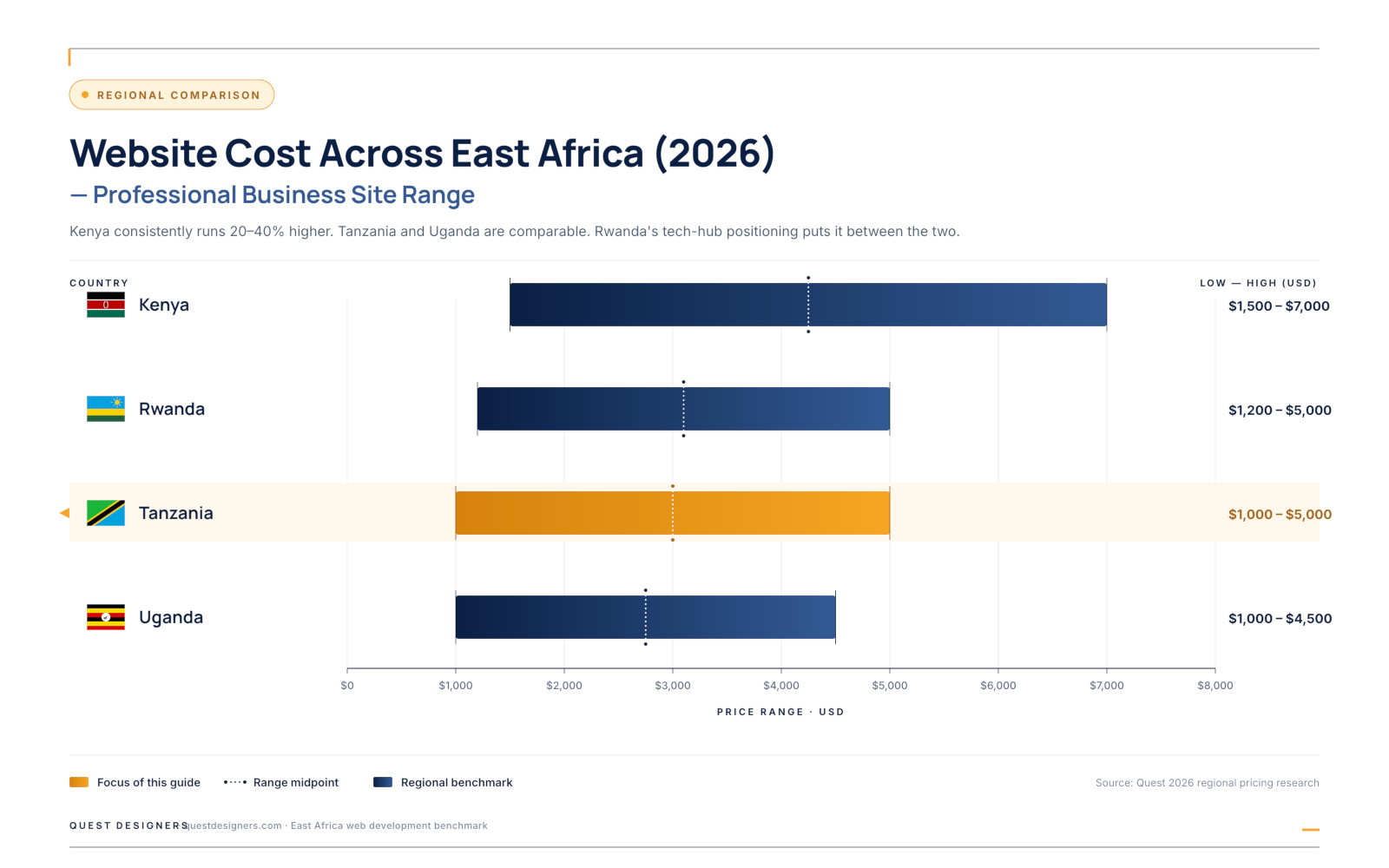
| Professional Business Site | $1,000 – $5,000 | $1,500 – $7,000 | $1,000 – $4,500 | $1,200 – $5,000 |
| E-Commerce (with mobile money) | $2,000 – $15,000 | $3,000 – $18,000 | $2,000 – $12,000 | $2,500 – $14,000 |
| Custom Web Application | $5,000 – $25,000 | $7,000 – $35,000 | $5,000 – $22,000 | $6,000 – $25,000 |
| Enterprise Portal | $10,000 – $50,000+ | $15,000 – $60,000+ | $10,000 – $45,000+ | $12,000 – $50,000+ |
Key takeaways from this comparison:
- Kenya (especially Nairobi) is consistently 20-40% more expensive than Tanzania. But Kenya also has a larger, more mature talent pool, more established agencies, and a longer track record in digital services. You're paying for that experience and reliability. Our Kenya pricing guide breaks this down in detail.
- Uganda is very comparable to Tanzania in pricing. During a trip to Kampala, I met Ugandan content creators and developers whose work was outstanding — and their rates were competitive. The market is growing fast.
- Rwanda is investing heavily in tech (Kigali is positioning itself as a tech hub), and prices reflect that ambition — slightly above Tanzania but below Kenya.
- The regional advantage: Working with an East African agency means you get someone who understands M-Pesa, mobile-first design, Swahili-English bilingual content, and the nuances of doing business in this region. A developer in Mumbai or Bucharest simply won't have that context, no matter how good their code is.
For a full overview of web design services across the region, visit our East African locations page. Quest serves clients across Kenya, Tanzania, Uganda, and beyond — because great web design shouldn't stop at the border.
Global e-commerce is growing fast — UNCTAD's Digital Economy Report 2024 notes that B2C e-commerce sales reached roughly $27 trillion worldwide. Tanzania is climbing steadily within East Africa, and the businesses that invest in a quality web presence now will be the ones leading when the local gap narrows — and it will narrow.
Frequently Asked Questions About Website Costs in Tanzania
Ready to Build Your Website in Tanzania? Here's Your Next Step
Let me wrap this up with the key takeaways, because I know that was a lot of information.
Website cost in Tanzania 2026 ranges from $100 for a basic template site to $50,000+ for enterprise-grade platforms. For most Tanzanian businesses — the SMEs, the tour operators, the growing startups — the sweet spot sits between $1,500 and $5,000 for a professional website that actually works, looks good on mobile, and can grow with your business.
The factors that drive cost are predictable: design complexity, payment integration (especially mobile money — budget for it!), content volume, and whether you choose a freelancer, agency, or DIY approach. The hidden costs — hosting, maintenance, domain renewal, SEO — are just as real as the build cost, so plan for them from day one.
My Tanzanian editor Amina once told me: "Tunaandika kama mazungumzo" — we write like conversation. I've tried to do that here. Not to overwhelm you with jargon, but to give you the real numbers, the honest advice, and the practical steps you need to make a smart decision.
Here's what I'd suggest as your next step:
- Define your requirements. Write down what your website needs to do — not what it needs to look like, but what it needs to achieve.
- Set a realistic budget. Use the ranges in this guide as your baseline. Include Year 1 recurring costs in your planning.
- Talk to professionals. Get 2-3 quotes from established providers. Compare scope, not just price.
And if you want a partner who understands the East African market — from Dar es Salaam to Zanzibar to Dodoma and beyond — Quest has been designing websites for businesses across the region for years. We understand mobile money integration, Swahili-English content, mobile-first design, and the unique challenges of doing business in East Africa.
Because at the end of the day, your website should have a heartbeat. It should feel like your business, speak to your customers, and work for your market. That's not something a $100 template can deliver. But it is something a smart investment and the right team can build.
Karibu sana. Get in touch with us for a free consultation and quote — let's build something worth sharing.
Need a Professional Website for Your Tanzanian Business?
Quest designs high-performance websites for businesses across East Africa — including Tanzania, Zanzibar, and Dodoma. From tourism booking sites to e-commerce platforms with mobile money integration, we build websites that work for your market. Get a free quote today →